

Patti's After-Party: Christopher Wyze & The Tellers Pay Tribute to Blues Greats Leroy Carr and Scrapper Blackwell
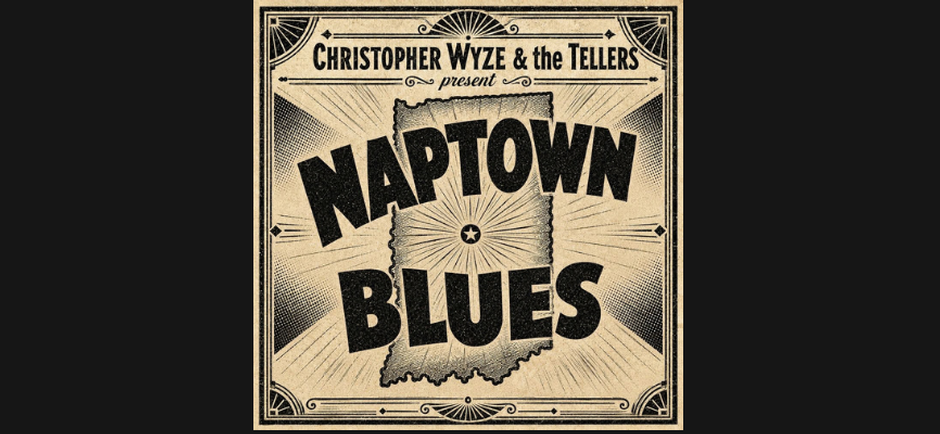

This is for serious blues fans, history fans, those with ties to Indianapolis and most of all, I’d like to think it’s for the “blues curious” people. This wasn’t my first rodeo with Christopher Wyze & The Tellers, but it sure turned out to be a magnificent learning experience. I gained so much new information about music and other miscellaneous things and I loved this interview. I’ve got fun facts to spark dinner conversations for quite some time after this one.
Let’s dig right in. The assignment was to promote the new single “Naptown Blues” by Christopher Wyze & The Tellers. In case you’re unfamiliar with them, they are a blues band based in Indianapolis, Indiana. From my own experience in that part of the country, the people there are incredibly friendly and put on no airs. They’re exactly what you might expect from Midwesterners and Christopher Wyze is definitely one of them. Easy to talk to and so passionate about what he does.
What you need to know about “Naptown Blues” is it was originally recorded in Indianapolis by a couple of guys named Leroy Carr and Francis Hillman “Scrapper” Blackwell way back in 1929. “Naptown” is a nickname for Indianapolis and originated from the fourth syllable in “IndiaNAPolis.” As you can imagine, Carr and Blackwell were blues musicians, with Carr being a piano player and Blackwell a guitarist. Before I get ahead of myself, I just want to give a little background on Christopher Wyze and you’ll understand what prompted him to cover Carr and Blackwell’s 1929 song (and even more).
I asked Wyze if he was always into the blues. He told me grew up singing in choirs and orchestras. Along the way he sang all parts of Handel’s “Messiah,” first tenor, second tenor, baritone and bass. He loved singing, but then life barged in and he became an “advertising dude.” He also wrote for a newspaper, a magazine and eventually ended up owning an advertising agency. When you think of it, he was ripe to become a songwriter based on his past experience, but that didn’t happen right away, it evolved in an interesting way.
“I’m a writer,” shared Wyze, “that’s my basis, but I was always around music. I forgot about it, mostly because of my career, but I liked it. I was kind of a rock and roller guy. I remember when my brother was in college he came home with B.B. King and Bobby Bland’s album Together for the First Time… Live (1974) and I remember hearing the blues and thinking, ‘This is crazy.’ So it was always kinda there and then fast forward to about 2007, through wild circumstances I found myself singing again.”
It was at a church wine dinner that Christopher Wyze wound up behind a microphone for the first time in a while. I’m not sure how it happened, but Wyze ended up chatting with one of the guys in the band. He mentioned he’d done some singing in the past and when the band’s singer took a break, he enlisted Wyze to get on up there and sing some songs. He did some Beatles and old Bruce Springsteen and people liked it. They liked it so much they hung around after the dinner was over and the music played on. After they were done playing, Wyze was ready to leave and said his goodbyes to the band, but not so fast Mr. Wyze, this wasn’t the end of the story. “Come back here, what’s your name? We’re having rehearsal next week, come on over, we need a frontman,” said the band guy. The next thing you know, Wyze is fronting a heavy blues band.
“We did a lot of blues, rock and roll and rock-blues, you know?” said Wyze. “So I sang the blues with them for a long, long time until 2024 when I released my own album of my own material. So I had 15 years of being a blues frontman and singing and playing in a band. I was performing and learning the harmonica. All that brought us to today and my first album which came out in 2024, which seems like 10 years ago because it’s been such a crazy ride. I’ve now got my third album that’s soon to be out there. I signed a record deal with Big Radio Records out of Memphis which is owned and operated by Sam Phillips’ nephew Johnny Phillips and his brother (yes, that would be Sam Phillips of Sun Records fame), it’s just a crazy, ‘pinch me’ kind of thing. I also write blues now and I’m going to Muscle Shoals soon to record my next album of all-new material.” So there it is. The history of Christopher Wyze’s journey to leading a blues band.
Now back to Leroy Carr and Scrapper Blackwell and “Naptown Blues.” To clarify, “Naptown Blues” is a recent single for Christopher Wyze & The Tellers, but it’s also the title track to a full-length album set to release October 2nd on the Big Radio Records label. I listened to the single and told Wyze I thought it was a cool tune, but the older I get, the more I’m realizing how most blues music just oozes cool. That kicked us off into a little tangent that centered around my Center Stage Magazine bio. I figured the only one reading it was me, but I was wrong. Christopher Wyze read it and said he found my love of reading old newspapers and visiting cemeteries interesting. Oddly, those hobbies of mine fit in quite nicely with our discussion of Carr and Blackwell.
Wyze began, “Our album comes out October 2nd. It’s done and in the can, but it’s funny when you say the blues are ‘cool.’ I’m sure I was a dork when I was a kid, but I’m with you, the blues are pretty cool. These guys, Leroy Carr and Scrapper Blackwell, were layin’ down cool in the 1920s. I was reading your bio and I saw that you kind of get into old newspapers and cemeteries. Well, I’ve dug my head into old newspapers and a lot of old black newspapers here in America to find out about these guys. Unfortunately, there’s not a lot, they weren’t covered like the big non-black stars of the day. The other thing is, you said ‘cemeteries’ in your bio, and so a couple Fridays ago I was at Leroy Carr’s cemetery and Scrapper Blackwell’s cemetery too. They’re both right here in Indianapolis where I live and where we recorded the album. I just had to do a tribute to these guys, you know?”
I asked him about their graves because naturally I’m into that sort of thing. I explained to Wyze why I love cemeteries so much. “Part of the reason I really love cemeteries is I do genealogy and that’s a big reason, but the other reason is I really hate walking, but if I’m walking with a purpose, then I like it. So if I’m walking through a cemetery, which is very peaceful, I also go through and read the gravestones and try to imagine what the life of the average Joe buried there was like. What was his life like? It gets my mind spinning around and I forget that I’m actually trying to do something healthy by walking.”
Wyze shared that his college was very near Crown Hill Cemetery, a large cemetery with the highest point in the city of Indianapolis. He and his buddies would drive through there, possibly with an adult beverage or two, and check out all the monuments, carvings and statuary. He then told me he enjoyed walking around trying to find the graves of Carr and Blackwell. “They were a little hard to find, I was going up and down all these rows and it was hard not to stop and look at stuff.” I know how that goes.
“You know their gravestones, interestingly enough, are fairly new,” he told me. “They’re from the 90s. A couple of deejays here in town got on a Leroy Carr and Scrapper Blackwell thing. I’m not even sure, but Scrapper’s grave might have been unmarked because when he passed away he was of very little means. Leroy Carr probably went out on top, but both of the gravestones are quite new. I kind of wish I knew what was there originally, but the ones there now are cool. Leroy’s has a piano keyboard and Scrapper’s has a guitar on it.” I commented that it was great that someone thought enough to remember them. I wondered if the disc jockeys did a fundraiser to buy the stones. Wyze said “I believe they did. They had a show and a whole thing. I went to the Indiana Historical Society looking for anything I could find about these guys. I found a poster, I think from 1994, for the fundraiser, so that was cool. I also learned that when the new graves went in, the governor of Indiana and the Indianapolis mayor declared a special day for these guys. It was a great way to honor them.”
Apart from learning about the new music, I was heavily into how happy I was to hear that Christopher Wyze & The Tellers were paying tribute to some hometown musicians from Indianapolis. I’m all about hometown pride, for myself and for anyone. No matter where we are in the world, most of us have a place we call our hometown, and for better or worse, we generally have things about that hometown we’ll always love. Wyze definitely loves Indy. He was able to elaborate on the “Naptown Blues” project and display his love for his hometown when he shared something else. “I went and filmed a whole bunch of stuff. I tromped around Indianapolis and found where Leroy lived. It’s an empty lot today, but we filmed over there. I went and found where Scrapper Blackwell was discovered murdered in an alley in 1962. We went to the Indianapolis Athletic Club building where these two guys, who had only met a few weeks earlier, recorded their first four songs. In fact, one of them was their biggest hit ever (“How Long, How Long Blues”). They made six different releases of it because the record company kept encouraging them to re-write the lyrics and issue another version so they could sell more records.”
Wyze went on, “Those songs were recorded right here in Indianapolis on portable recording equipment from Vocalion Records in Chicago. They came down to record them and some other acts on kind of a talent scouting mission. It kickstarted Leroy and Scrapper’s career and they went on for eight years until Leroy, unfortunately, passed away. He had a drinking problem and that’s what took him down. He was only 30 years old. A whole bunch of his songs centered around alcohol, which is sort of ironic. He’s got “Straight Alky Blues - Part I” and “Straight Alky Blues - Part II” and probably 10 other songs that revolve around drinkin’. That’s a good blues theme, but unfortunately, I think Leroy had a bit too much.”
What struck me as significant about all of this is that Carr and Blackwell were making their music right during Prohibition, which took place from January 1920 to December 1933. I couldn’t help mentioning that. Wyze responded with, “I was told that Scrapper was a bootlegger in 1928 when he was first introduced to Leroy Carr.” It seems bootlegging was running rampant all over the country at that time, so I don’t doubt that might be true.
As for the two men meeting and developing a musical partnership, Wyze said, “I don’t quite know what Leroy was doing at the time, but he was an accomplished piano player and he and Scrapper were introduced by a guy who owned the Indiana Avenue Music Shop, right here in Indianapolis, J. E. Guernsey. He was a Vocalion Records dealer. I don’t know where he got the idea, but he decided to introduce these guys and thought he’d see if he could get them to record. He had them go to his record store and he must have had a piano there because Leroy played for Scrapper. Scrapper said, 'I recognize that, that’s the blues.' In a 1960 interview, Scrapper talked about this, but it’s the only interview I know of him doing. So Guernsey, the record store owner said, ‘Let’s go up to Chicago and make some records,’ and Scrapper said, ‘No way. I got a business to run, my corn business.’ That’s what he called his bootlegging business. So Guernsey says, ‘What if I talk those guys from Chicago into coming down here? Would you do it?’ Obviously he agreed to that and Scrapper also said Guernsey bought him out of all of his booze so now he didn’t have too much to do, so there you go. Vocalion did come down and record them and I wish I could go back in time to just be there, but it actually happened and it’s a crazy story.”
When asked if every track on the upcoming album is a cover of a Leroy Carr and Scrapper Blackwell song, Wyze replied, “Yes and yes, but 10 of them are absolutely their tunes and the eleventh is called ‘Birthday in Jail,’ which is our interpretation of their song ‘Christmas in Jail.’ We thought it would have a better shelf life, you know?'" He laughed and added, “I actually recorded ‘Christmas in Jail’ in Memphis last September at Royal Studios, which is an amazing place. I recorded it with Al Green’s backing band, The Hi Rhythm Section. So if you listen to ‘Christmas in Jail’ by Christopher Wyze & The Tellers, my ‘Tellers’ that day were The Hi Rhythm Section who backed Al Green, the great soul singer.”
As for Carr and Blackwell, they influenced a good number of big artists, including Robert Johnson and Ray Charles. Christopher Wyze explained, “There’s no question that they were influential. You know it’s hard to say because the news coverage is so sparse, but what I can find is that they were a big deal, a really big deal. They recorded 200 records in the eight years they were together and for one of those years they didn’t record anything, so that’s 200 in seven years. They say that ‘How Long, How Long Blues,’ which was recorded on the first day they ever recorded together, was one of the first million-selling records, maybe in America. Keep in mind they were recording for Vocalion Records and Scrapper said in 1960 that Vocalion paid him and Leroy $4000.00 a piece. I happen to know that Leroy drove a Hupmobile and that was a very expensive car.” He then laughed and added, “I know that because it was stolen! There was even a notice in the paper about it when it was found. They were livin’ pretty high.”
With the newspaper coverage so lacking, do many people know Carr and Blackwell existed? Are they that obscure and lost to time, or do true blues fans know about them? Wyze stated, “I would say your deep-dyed in the wool blues fans know Leroy Carr and Scrapper Blackwell, but you’ve gotta be pretty well-dyed.” One can only hope those blues fans who aren’t yet aware of them will get turned on to them after the new album comes out.
About that album, at this time there are no concrete plans to celebrate its release, but some things are brewing in the background. According to Wyze, “At our public radio station here in Indianapolis, we’ve got a great blues show every Saturday night. It’s been going on for 30 years. We might be cookin’ up something and they’re just the perfect folks to collaborate with on something like this. They can help tell the story too. We want the world to know about this, specifically the people in Indianapolis who should know who these guys are. They’re really important.”
I couldn’t agree more, they are an important part of Indianapolis’ music history, but even if someone isn’t a blues fan, regular history buffs might be interested in learning about them. There are a lot of moving parts to Carr and Blackwell; one was murdered, one died young, one was a bootlegger. There are a lot of interesting tidbits in there. Wyze provided more details. “After Leroy died, Scrapper gave it up. He recorded a handful of songs after Leroy died and then he disappeared until 1959. So from 1935 to 1959, there was no Scrapper Blackwell. It’s even hard to figure out what he did. My guess is he had a tough life and there’s not much known about him, but somebody rediscovered him in 1959 and he started making records again. Ultimately, just out of the blue, he was murdered at age 59, right when he was making a comeback. (Blackwell was shot and killed during a mugging on October 7, 1959. His neighbor, Robert Beam, age 75, was arrested and charged with murder, although the crime is still listed as unsolved. As confusing as this sounds, it’s said that there is no final conviction on record.)
In researching Carr and Blackwell, Christopher Wyze was able to peruse the files of a writer named Duncan Schiedt at the Indiana Historical Society. Schiedt often wrote about jazz, but was familiar with the blues as well. He was one of the people involved in the early rediscovery of Scrapper Blackwell and helped him get a record deal in the UK. While going through Schiedt’s files, Wyze found the original contract from that deal, Blackwell’s copy. Wyze excitedly said, “It was in my hands, signed by Francis Hillman Blackwell, so it was kind of a creepy experience. To have his signature on that contract in my hand, it was like, ‘Oh my Lord!’ Also Francis was his first name. His grandma said he was kind of a feisty kid and she called him Scrapper when he was young, so that’s where he got his nickname.”
Among Christopher Wyze’s many talents, he’s also been writing and recording songs for film and TV and working with a producer in Nashville. That producer asked Wyze if he could do some old country music, so he recorded a couple of Ernest Tubb’s songs and exclaimed, “I can scarcely contain my enthusiasm for Ernest Tubb and his stories. I did ‘Thanks A Lot’ and ‘I’ll Get Along Somehow,’ and both of those are blues kinds of stories. I just recorded ‘Big River’ by Johnny Cash, another bluesy tune with great lyrics.”
Since Christopher Wyze was so forthcoming with information and cool little factoids, I decided to make him think a little. I posed the question of “If you could form your own blues supergroup with anyone living or dead, who would you put in it and who would play what?” Oh, he liked that question! Almost right away he answered, “Well, Freddie King would be there and he’d be playing guitar, and I might even let him sing because he sings so amazingly. Howlin’ Wolf would be there because we’d want to enthrall the audience. He was such an amazing performer, a great singer, harmonica and guitar player. I’d have Junior Wells play harmonica and sing too, and he’d just lay it down. I’m sure we’d have a drummer and a keyboardist, and who knows, maybe those guys would let me stand in the back of the stage and watch or something.” With a chuckle he added, “It would be fabulous!”
Speaking of drummers, when I listened to the “Naptown Blues” single, I thought I noticed a lack of drums. I guess I heard it correctly because when I brought it up, Wyze replied, “Good for you for noticing. Leroy and Scrapper did not record with drums. A lot of those early bluesmen didn’t record with percussion or drums. I don’t know why. The recording techniques of the day were much different. They were recording in the electric era so they had microphones and amplification. Shortly before that they just had big horns, those big things that looked like they were on a phonograph. Maybe that was a part of it, but it was Leroy on the piano and Scrapper on guitar. Both of them sang, but rarely together, and that was it. When we put this project together, I said, ‘Hey fellas, there are three Tellers that are Indianapolis folks, me, Gerry (Murphy) on bass and John (Boyle) on guitar. Dudes, we need to make an album in Indianapolis, for Indianapolis and the world about Indianapolis bluesmen Leroy and Scrapper. We need to do it respectfully and the way that they did it.”
In an effort to create music the way Carr and Blackwell did back in the 20s and 30s, Wyze and The Tellers knew they needed to conjure up a certain “feel.” They didn’t want a heavy percussion-driven sound and they were going for something really melodic. They recorded on tape because they all loved the sound of it. They recorded at Postal Recording in Indianapolis, about two miles south of where Carr and Blackwell first met and recorded. Wyze expanded on the recording process. “It’s in an old post office and it’s quite possible that that post office delivered Scrapper Blackwell's mail because he lived in that area. In the studio we tried to do it without a lot of retakes and overdubs. When we were listening to it in the control room we’d hear something we wished we had done differently, and then we’d think, ‘You know what? They didn’t get another chance.’ So we left it in.” I’d already heard “Naptown Blues,” so I shared my thoughts. “It’s raw and that’s the best way to pay tribute to them.” Carr and Blackwell didn’t have all the bells, whistles and trickery that exists today. They were talented musicians that recorded unrefined songs. Those songs sold a lot of records and obviously nobody complained about those songs being overprocessed or the products of AI.
Since I brought up the single, Wyze said, “I’ll tell you what, 'Naptown Blues,' that song is so crazy. I never heard a song like that and I thought, ‘Dang, I’ve gotta do this song.’ It’s wild and crazy and it’s jazz-era. It’s Naptown and it’s swingin’.” I replied, “It’s a bit chaotic, which makes it really cool. You did a good job with it.” When I used the word “chaotic,” I meant it in a positive way. There’s a lot going on, but I think me trying to describe it would pale in comparison to everyone just giving it a listen. You can do that right now by clicking HERE.
The album boasts a majority of Carr and Blackwell’s more obscure tunes and Wyze described the track list a bit. “We did put on ‘How Long, How Long Blues’ which was a huge hit for those guys. We also included ‘Midnight Hour Blues’ and that’s a well-known blues standard, but we also have some others that I don’t know that anybody’s covered. I don’t know if anyone’s covered ‘Naptown Blues.’ I know Wes Montgomery, the great jazz guitarist, played a song called ‘Naptown Blues,’ and it doesn’t sound anything like Leroy and Scrapper’s tune. Song titles can’t be copyrighted, so they’re free game. Wes Montgomery played his own ‘Naptown Blues,’ not Leroy and Scrapper’s.”
Don’t expect Christopher Wyze and The Tellers to be touring anytime soon, but it isn’t because they don’t want to, it’s just a matter of having time to build a tour with everything else happening with the band. Wyze conveyed the current obstacles. “I would love to tour, because the thing I love most is performing, but for whatever reason the drive to write and record songs has taken me over and that’s become a bit of a full-time job. I also run an advertising agency. I’m basically the creative director for Christopher Wyze & The Tellers and I’m a songwriter so I write songs, most of them with my friend Ralph Carter. I’m a vocalist, a harp (harmonica) player, the marketing director and I write all the content for the band. I just haven’t been able to add one more thing to the docket. We might get out for the next festival season, I just feel a compunction to get these songs out of me when they come to me.”
He explained that he didn’t become a songwriter until fairly recently, but he was a writer and penned five books. He said, “I’ve written millions of words that people somehow convinced themselves to write me a check to write, so I know about it, I know how to make words go together.” Is it a big jump to go from writing books to writing songs? I guess it depends who you ask, but as for Christopher Wyze, he had some help making the transition. “My friend Ralph Carter used to write songs and perform with Eddie Money and he acted as his touring musical director. I met him in Clarksdale, Mississippi. He asked me, ‘Why aren’t you writing songs?’ I had never thought about it, and lo and behold, he finally convinced me to do it. We met back in Clarksdale and I had a pile of lyrics. It was the early part of 2022. He and I sat at a picnic table for three days, Ralph with his guitar and me with my lyrics and an iPhone. We made the songs we wrote into demos and a few months later we found ourselves in Muscle Shoals, Alabama recording an album. Ralph’s a producer so he knows how to do that. It’s been crazy. I didn’t even have a name for the band then. I just wanted to record these songs that Ralph said we could do together.”
The next step Wyze took was a mentor session with Jim Reilley at the Nashville Songwriters Association. “He listened to my music,” shared Wyze, “and he was like ‘Where have you been man? What are you gonna do with this? I would buy this.’ I said, ‘I wanna get a record label.’ He shot back, ‘No, you don’t want a record label, do it yourself.’ Then I said, ‘No, I’m not gonna do that. I’m a writer, I’ve got a publisher and I understand what that does for me, I need that.’ He finally said, 'Okay, I’ll introduce you to Johnny Phillips,' and so he did and I’ve been runnin’ ever since.”
The story Wyze shared with me next borders on the really weird and wildly wonderful. Do you believe in coincidences? How about manifesting something into being? Or maybe you just think everything happens just because it does. In any case, give this tale a whirl. I enjoyed it.
“One of the songs on my first album is called ‘Three Hours from Memphis.’ I was driving to Memphis to meet Ralph Carter who lives in Ventura, California. I picked him up from the airport and we were gonna go sit down at that picnic table in Clarksdale, an hour and a half away. On the way down, I looked at my GPS in my Ford Explorer and it said I had three hours to Memphis. I said it out loud, ‘Three hours to Memphis. Three Hours to Memphis. Three Hours to Memphis, oh crap! That’s a song!’ I sat in the car and as I zoomed down the highway, I wrote all of the lyrics to that song. The song just hit me in the head. The premise is a guy is on his way to Memphis and he’s gonna meet a record guy. Some guy heard his stuff and liked it and now he’s going there to make his songs. He’s paid his dues for 15 years and now his time has come.”
He continued, “A couple days later Ralph and I made it into a song and here’s the funny thing, I didn’t know anyone in Memphis. I wasn’t on my way to meet a record man. I had no idea I’d write a few hit songs, at least in the blues world, because we have had a couple that made it to the top of certain charts. So this song that I wrote in advance turned out to be my autobiography. I did meet a record guy. He did help me write hit songs. They are in Memphis. I did pay my dues for 15 years. It’s just spooky. Now I just have to keep writing these songs. There’s something going on here that I don’t understand.”
By this point, he had mentioned Clarksdale, Mississippi several times. If you’ve been to Clarksdale, you know, but if you haven’t, it’s not a big place. It’s a really small one. I’ve been there a couple of times and I didn’t just pass through, I stayed there. If you want to experience one of the coolest spots on Earth, you need to get yourself to The Shack Up Inn in Clarksdale before you die. Nothing I can say can prepare you for it. It’s so unique. Just imagine a group of shacks spread out over a plot of land that’s surrounded by cotton fields and not much else. Each of those shacks surrounds a central hub of sorts, a large building that’s kind of like a barn and acts as the epicenter. That’s where you can experience live music (a lot of blues), get a meal and visit the gift shop. It’s not fancy, it’s better! You can stay in one of the small shacks, or if you want to get “luxurious,” you might consider one of the Sky Shacks. I was fortunate to stay in one of them and it remains one of the best memories I have. The good times there are worth every cent you’ll shell out to stay there, but the thing is, it’s so reasonable! If you’re interested in checking it out, visit shackupinn.com.
Why am I rambling about a bunch of shacks in the middle of rural Mississippi? Because I just had a feeling that the picnic table Christopher Wyze and Ralph Carter were writing at was probably located at The Shack Up Inn. I mean, it’s not like there’s that much going on around those parts and there were definitely picnic tables at The Shack Up Inn. One of my favorite parts of our interview was when I mentioned how The Shack Up was one of my favorite places in the world, and Wyze exclaimed, “That’s the picnic table!” I knew it, I just knew it.
While I’ve only had two occasions to visit the hallowed ground of The Shack Up Inn, Wyze said he’s been there about 15 times and one of those times he filmed a documentary. “It’s called Wyze in Clarksdale. It’s a 50 minute documentary. I did a live album at the Juke Joint Chapel there at the Shack Up Inn, it’s called Live in Clarksdale and it was my second album.” I guess bringing up this little nirvana in Mississippi was a good conversation starter (and if you ever go there you’ll find the place generates all kinds of conversations you never knew you’d have) because Wyze had a lot to say about it, and away he went!
“I also ended up filming the live show and you can see it on my YouTube channel. I worked with a guy named Coop Cooper, he’s a Clarksdale filmmaker and he filmed the show. I’ve had him do some other things with me as well. He’s a great dude. So I thought, ‘Why don’t Coop and I just walk around Clarksdale and film it and make a documentary?’ It just kept eatin’ at me, so around Christmas I called him and asked what he was doing right after Christmas because I had an idea. Long story short, I arrived in Clarksdale on December 28th with Gerry Murphy, my bass player, who agreed that whatever we needed, he’d help to make this happen. So he and I wandered around Clarksdale for two days and we made the film Wyze in Clarksdale. Yeah, I’m really into Clarksdale. I’m going back there in a few weeks to put the finishing touches on our song before we go to Muscle Shoals.”
I responded, “There’s something magical in that dinky little town.”
As the interview was winding down, I grabbed a box of icebreaker-type questions and randomly selected one. It read, “If you could have 50 pounds of anything other than money, what would you want?”
Wyze laughed and said, “I’m gonna assume there’s no downside to me having it. This is gonna be stupid, but I’d love to have 50 pounds of barbeque potato chips because I’m just an absolute sucker for ‘em. That’s not very cool, but that would be a dream. They might have to be Grippo’s potato chips because they’re the best. (Author’s note: I had never heard of Grippo’s, but the next time I’m in Indiana, I’m seeking them out, but not quite 50 pounds of them.)
Finally, because we are Center Stage Magazine, I asked Wyze to share a memory where he felt like he was “center stage.”
After barely a few seconds, he replied, “Probably when I was in seventh grade, I was in choir and I had a solo. I sang 'Sunny,' the Bobby Hebb song. I suppose it’s kind of a bluesy song. It was in the evening and our parents were there. I was out front and my mother was tearing up. It was wonderful and I think it never left me. I still would rather be in front of a microphone than any place, maybe on the planet.”
If you didn't feel the fire Wyze has for the blues, his band and of course, Leroy Carr and Scrapper Blackwell, I suggest you start over and read this interview again. Or maybe mere words can't convey that kind of passion, but trust me, this guy is a go-getter and he's so excited to share his music and his knowledge about the genre. He's constantly trying to learn more and that says all you need to know.
Keep up with Christopher Wyze & The Tellers on social media and their website. Give him a holler and let him know Center Stage Magazine sent you! We'd appreciate that!
About Patti McClintic
 Journalist
I’m a pop culture and history nerd. I love my family, friends, random trivia and animals. I found out early I had a natural knack for creating stories and finding my way around the English language. Writing came easy for me. If I was going to write about anything, pop culture seemed like a good choice.
I spent 10 years writing for UK-based Think Country. I’ve interviewed countless artists and reviewed many shows and records. I’ve written show reviews on Charlie Daniels, Florida Georgia Line, Merle Haggard, The Cadillac Three, Randy Travis and multiple CMA Fests. Artists I’ve interviewed include Brett Eldredge, Carly Pierce, Ashley McBryde, Lonestar, Lainey Wilson and Jeannie Seely, to name just a few.
I also had a three year stint working in public relations in Nashville. I learned so much more by seeing the music business from the other side. I am forever grateful to have been given that opportunity at B Noticed PR, a highly-respected PR firm, whose clients have included Exile, Jeannie Seely, Allie Colleen, Brady Seals and Adam Hood.
When I’m not involved in the music industry, you can find me hanging out with my husband, playing cornhole or fishing. I’m a genealogy addict and I love perusing very old newspapers and cemeteries. I’m a proud mom and grandma, so family matters a lot to me, even my cat family members. I’m thrilled to be a part of Center Stage Magazine and looking forward to whatever comes my way while I’m here. There’s really nothing else like it.
